
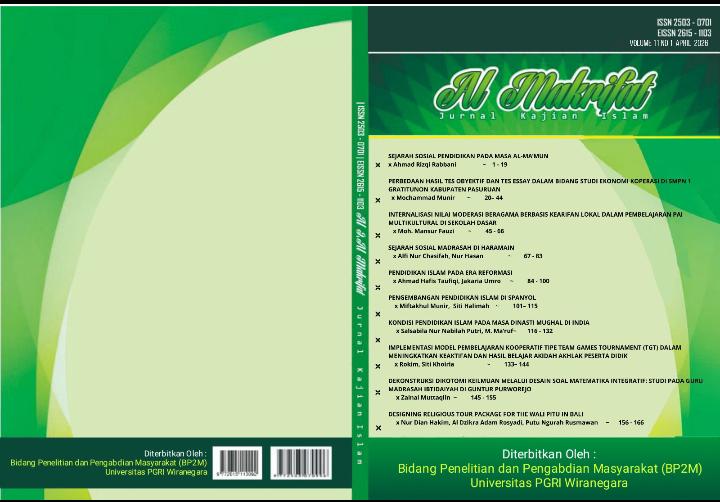
Sejarah Sosial Madrasah Di Haramain
Keywords:
Madrasah History, Social Haramain, Islamic Education
Abstract
The social history of madrasas in Haramain, namely Mecca and Medina, is an integral part of the development of Islamic education which is removed from the scientific traditions in mosques. In the beginning, these places of worship functioned as learning centers, where students came to study religious knowledge. Over time, the need for more sustainable education prompted the transformation of mosques into madrasas. The first madrasah to be formally recognized was **Nizhamiyah Madrasah**, founded in the 11th century AD by Nizham al-Mulk, which became a model for subsequent madrasas. The cities of Mecca and Medina are centers of religious knowledge, so many Muslims in the world go there to seek knowledge in addition to performing the Hajj. The rise of the Haramain madrasah was motivated by internal and external factors. The Haramain madrasah was mostly founded by rulers and non-Hijaz philanthropists and this madrasah also had a dependence on its founder, while the discourse of knowledge revolved around the sciences of fiqh, tafsir, hadith, tasawuf and science. Keywords: Madrasah History, Social Haramain, Islamic EducationReferences
Azra, Azyumardi, Jaringan Ulama Timur Tengah dan Kepulauan Nusantara Abad XVII dan XVIII. Mizan, Bandung, 1994.
Emroni, Madrasah Masa Pertengahan:Kasus Madrasah Haramain, Jurnal Darussalam Volume 8, 2009
Hillandbrad. Madrasah dalam the enclyclopedia of islam,Leiden: E.J.Bill. 1986
Madisen, George, “Muslim Instituions of Learning in Eleventh Century Baghdad", dalam Religion, Law and Learning in Classical Islam. Great Britai, Varium, 1991,
Maksum, Madrasah Sejarah & Perkembangan ,Bukit Pemulang Indah Pt Logos Wacana Ilmu, 1999.
Ma'ruf, Naji, Madaris Qabl al-Nizhamiyah. al-Majma’ al-Ilmi al-‘Iraqi, Baghdad, 1973
Suwito ,Sejarah Sosial Pendidikan Islam, Jakarata, Kencena,2005
van Bruinessen, Martin, Kitab Kuning, Pesantren dan Tarekat.1999
Emroni, Madrasah Masa Pertengahan:Kasus Madrasah Haramain, Jurnal Darussalam Volume 8, 2009
Hillandbrad. Madrasah dalam the enclyclopedia of islam,Leiden: E.J.Bill. 1986
Madisen, George, “Muslim Instituions of Learning in Eleventh Century Baghdad", dalam Religion, Law and Learning in Classical Islam. Great Britai, Varium, 1991,
Maksum, Madrasah Sejarah & Perkembangan ,Bukit Pemulang Indah Pt Logos Wacana Ilmu, 1999.
Ma'ruf, Naji, Madaris Qabl al-Nizhamiyah. al-Majma’ al-Ilmi al-‘Iraqi, Baghdad, 1973
Suwito ,Sejarah Sosial Pendidikan Islam, Jakarata, Kencena,2005
van Bruinessen, Martin, Kitab Kuning, Pesantren dan Tarekat.1999
Published
2026-04-29
How to Cite
Nurhasan, A. N. C. (2026). Sejarah Sosial Madrasah Di Haramain. Al-Makrifat: Jurnal Kajian Islam, 11(1), 67-83. Retrieved from https://ejournal.kopertais4.or.id/tapalkuda/index.php/makrifat/article/view/7310
Section
Articles